Curiosity & Creativity:
an introspective analysis & reflection of five multi-disciplinary projects
In the post-digital era of Gen AI and Chat-GPT, the desire for authenticity and human creation is rising in all aspects of life. Showcasing my critical thinking skills is not just a box to check, but a genuine signature I carry in my future career.
❋ Intentional & Sentimental❋ Forever Curious❋ Flexible & Adaptable❋ Creativity is KeyRoots of Critical Thinking & Perspective
Throughout the past four years at Bowling Green State University, I am grateful for my experience in the Honors College that has fostered an innate sense of curiosity and a desire to investigate the systems and processes that make up our world. Paired with my design aptitude, this curiosity-driven skillset makes for a remarkable combination that guides my research and design process.
Below, I have chosen a variety of projects that encapsulates the core aspects of critical thinking (depicted on the right) and showcases the integration of these skills both in and beyond the classroom.
Click the titles below to explore more!
-
Describe and compare own cultural values, biases, and perspectives with those important to others to evaluate local, national, and global issues from multiple cultures and worldviews
-
Analyze and evaluate the issue, reasons, evidence and conclusion presented in different modalities and for different audiences, making inferences to identify assumptions and biases, and researching the issues, historical, and political context using an interdisciplinary approach
-
Create original, imaginative, and/or innovative solutions for complex problems that draw from multiple disciplines, balance divergent and convergent thinking, and synthesize and transfer experiences, classroom learning, and research
-
Demonstrate collaborative discussion skills by posing questions, listening actively, imparting thoughts, opinions and/or arguments, and building on and making connections between the contributions of others to foster mutual and interdisciplinary understanding
-
Communicate thoughts, opinions and/or arguments in a clear, concise manner through polished presentations and texts that utilize a variety of genre, modes, styles and accessible technologies appropriate for audience and purpose
Recycling Infrastructure Research
❋ Critical Thinking for Creativity and Complex Problem Solving: Problem Analysis
Highlighting research conducted on the wicked problem of the US Recycling Infrastructure, this five-page paper analyzes the layers and complexities of this issue through a social impact lens. It spotlights community organizations and partners actively attempting to mitigate this problem.
❋ Critical Thinking for Creativity and Complex Problem Solving: Solution Generation
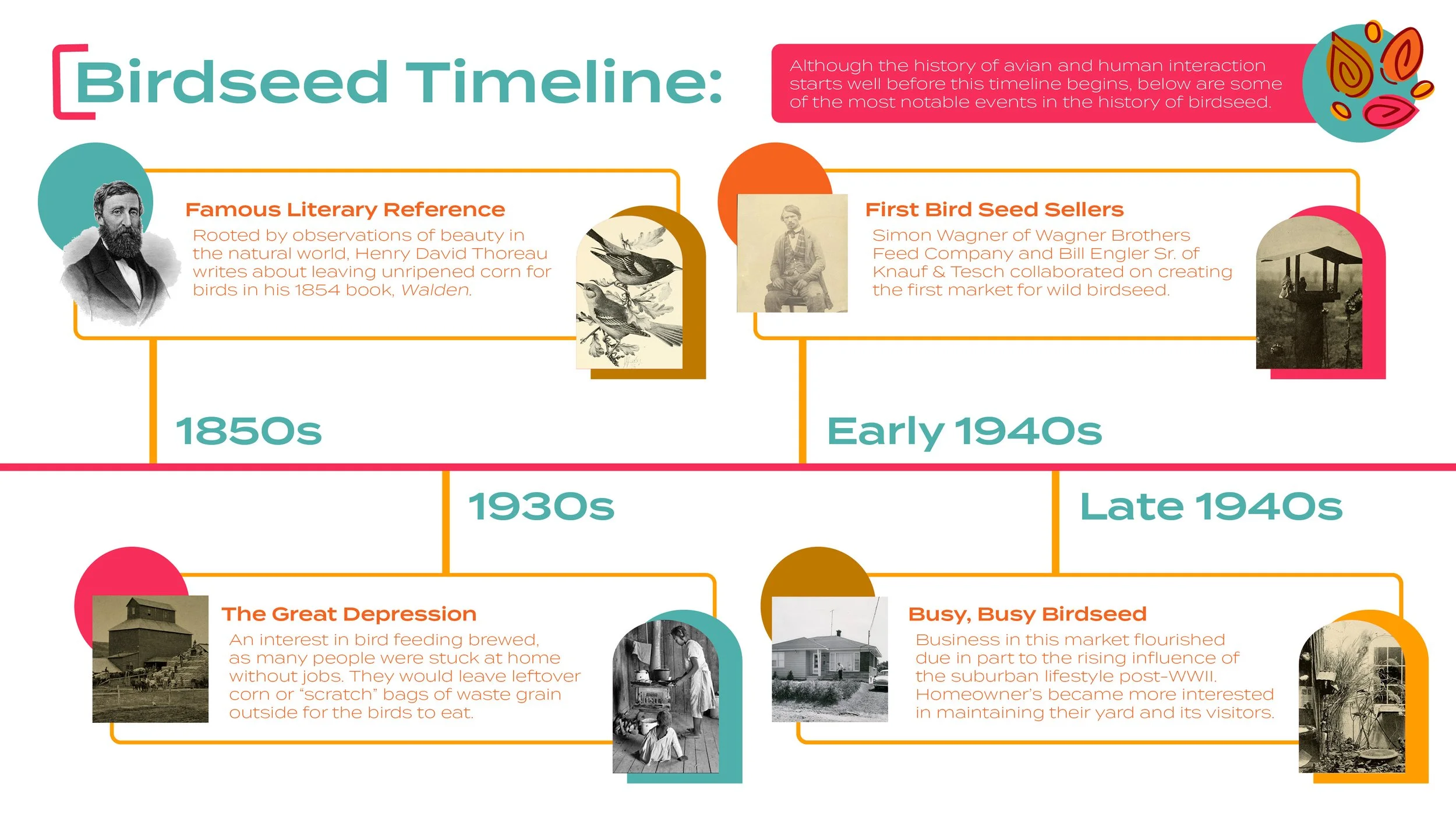
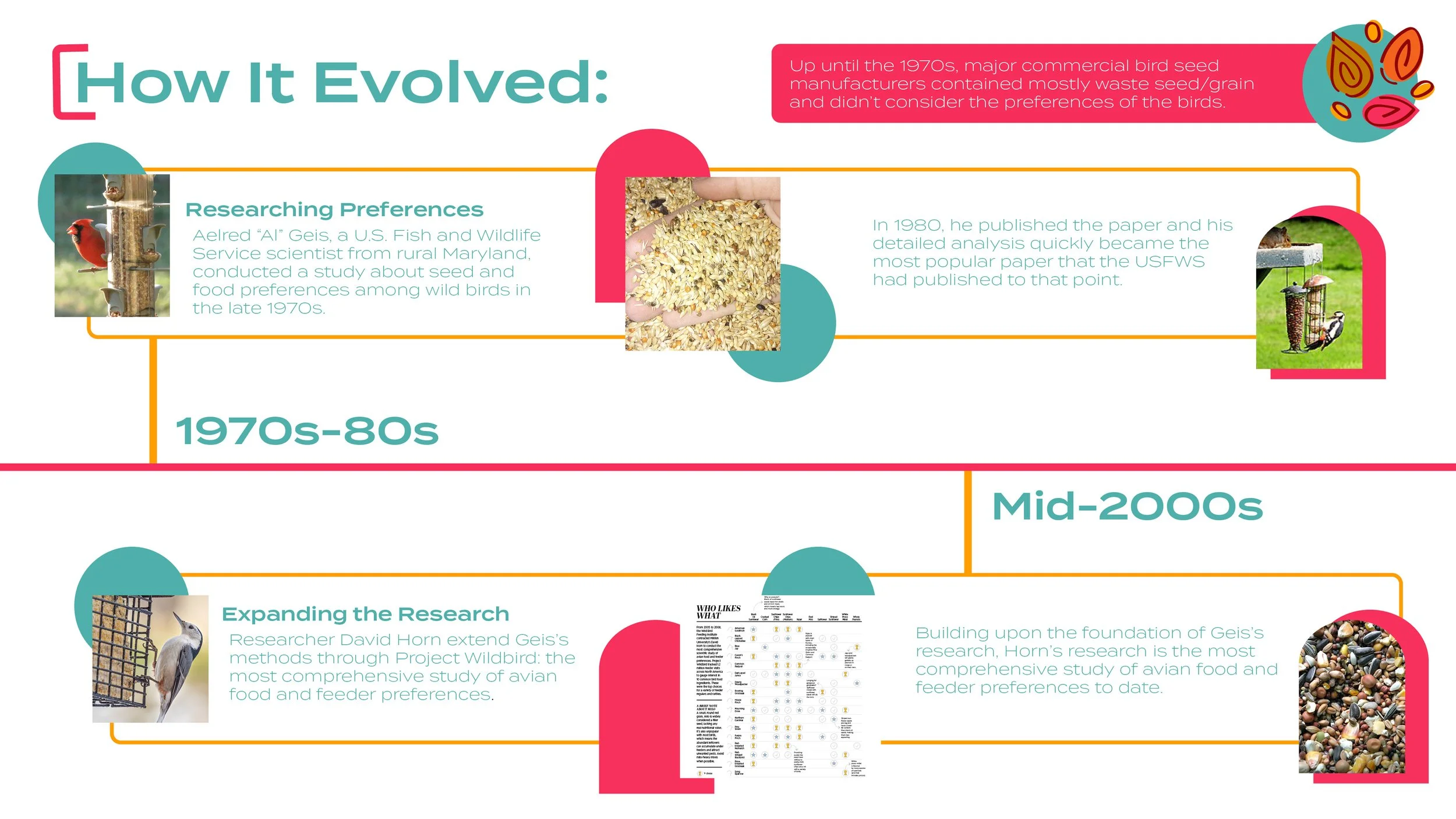
From interview and brainstorm to design and prototype, this social impact project focuses on taking an everyday object and exploring how it works and where it falls short. This creative project explores a new take on traditionally packaged birdseed, by offering a solution that preserves freshness, prevents spillage, mitigates plastic waste, and provides better accessibility for all ages to enjoy feeding their feathery friends.
In the Roots: Ohio’s Native Plants
❋ Critical Thinking for Communication - Discussion
This student-led exhibition was inspired Robin Wall Kimmerer’s book, Braiding Sweetgrass. As a collaboration between an undergraduate Collaborative and Community Engagement Practicum and a graduate museum studies course, this exhibition sought to honor Dr. Kimmerer’s message and connect it to a sense of place in Northwest Ohio.
❋ Critical Thinking for Communication and Dissemination of Ideas
Through a 50-page book, this project highlights research conducted how paper ephemera is collected and conceptualized by young adults, ages twenty to twenty-five, given the lens of the digital age. It deciphers how these collecting habits manifest, how they contribute to a greater sense of self, and how the collected paper pieces illuminate the interconnections of us all.
❋ Critical Thinking for Interpersonal and Intercultural Understanding
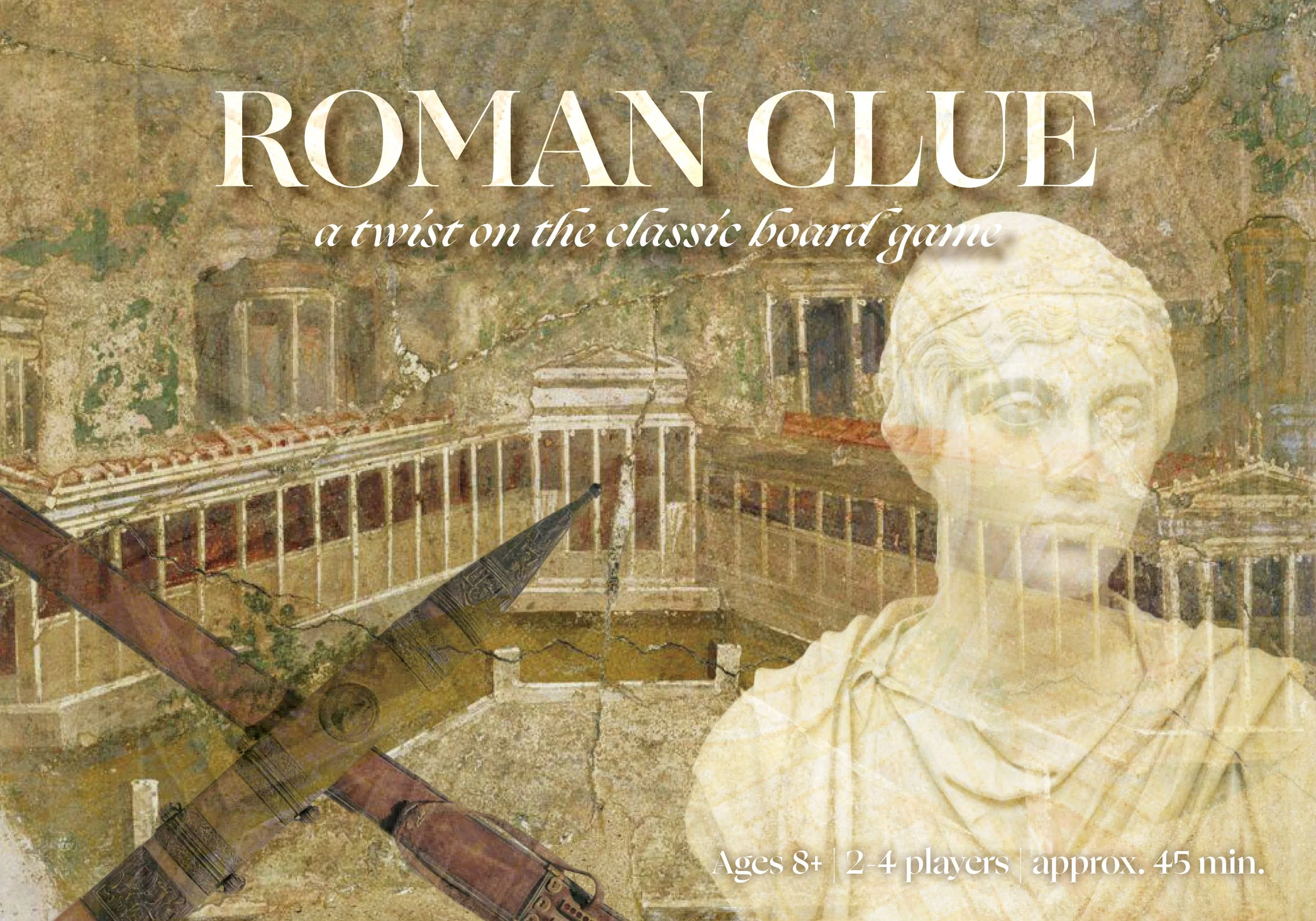
This interdisciplinary research project combines art history, graphic design, and education for the creation of a Clue-inspired board game that takes place in a Roman-style house. The game can utilized in a classroom setting to meet both curriculum learning goals and increase engagement with the content. It aligns itself with UDL or universal design for learning, to embrace and engage students through learning and play while rewarding critical thinking and curiosity.
2024 | Critical Thinking for Creativity and Complex Problem AnalysisRecycling Infrastructure Research
Overview and Key Ideas:
The US Recycling Infrastructure: A Fractured System in Need of Sustainability-Focused Change is a comprehensive analysis on the wicked problem of recycling in the US. It dissects this issue from a social impact lens focused on defining it, analyzing its layers, highlighting current efforts to mitigate it, and discussing potential next steps. This paper identifies current societal mindsets and misconceptions, while critiquing the systems and structures in place. It addresses the concepts of circular economy and sustainability, and it promotes existing recycle hubs and educational programs, while encouraging the emulation of this framework in other communities.
“We don't need a handful of people doing zero waste perfectly, we need millions of people doing it imperfectly.”
Anne Marie Bonneau | Cincinnati Recycling and Reuse Hub
❋
Assignment details
Written during my Design for Social Impact Course in 2024
Specifics to reach: research a wicked problem associated with a societal need, analyze its layers and complexities, and identify a community partner addressing this issue
Reflection & Analysis:
With complex problem analysis, it is imperative to evaluate the issue on several scales, which helps identify its varying interconnected layers. In considering the issue from a large societal understanding to hyper-focusing on a specific community, navigating the ambiguity surrounding wicked problems becomes more manageable for all.
While this essay does a great job at highlighting the local community work conducted by the Cincinnati Recycling and Reuse Hub, it does fall short in providing more resources to implement this framework further within the paper's call to action. Additionally, this essay could be strengthened with an in-depth historical analysis of the recycling infrastructure for a more comprehensive look into how the system has evolved overtime.
❋
“Each of these items have a life of their own, one that you—or a multitude of many others—had a hand in creating.”
Madelyn Junk (Lingering Sentiment, 2026, pg. 1)
2026 | Critical Thinking for Communication—Dissemination of IdeasLingering Sentiment
Overview and Key Ideas:
How does paper encapsulate and immortalize our lived experiences?
Lingering Sentiment is a research-driven project focused on uncovering how ephemeral paper is collected and conceptualized by young adults, ages twenty to twenty-five, given the lens of the digital age. The final output is a written and designed paperback book defining paper ephemera; dissecting how and why it is collected, stored, and discarded; and analyzing how these papers contribute to a greater sense of collective humanity.
From this baseline, the book explores how these topics are interconnected with themes of emotional attachment, digital unknowns, sustainability, identity, ownership, and grief. Supported by academic research alongside public collections and personal paper items, this book showcases a comprehensive analysis voiced within a poetic personal narrative.
Lingering Sentiment takes readers on a journey of self-reflection and introspection as they unfold how paper proves their very existence by its fibers and ink. Made to inspire hope and drive human connection, this book is tied deeply to empowering readers to find strength in their sentimentality and in their humanity.
Independent research project completed over Fall 2025-Spring 2026 to be displayed at the 2026 BFA Exhibition in March.
Specifics: Dive into a research question over a 15-week period. Form research into an appropriate finalized form.
Project details
Reflection & Analysis:
In dissecting this project under the lens of critical thinking for communication with the dissemination of ideas, it is imperative to highlight that this project presents its research in an engaging and informative way. It utilizes pictures, smaller paragraph chunks, and a structured grid to prevent overwhelm or information overload throughout its 50 pages. There is a strong, consistent voice felt throughout the pages that conveys its message, while still holding onto its research ties.
While this project does a great job of covering the breadth of several concepts surrounding paper ephemera, it does fall short in depth. It briefly touches on several topics like ownership, emotional attachment, and hoarding throughout several pages, but it could benefit greatly from a deeper breakdown on these complex and nuanced topics with a page or two dedicated to each topic. Additionally, this book could be strengthened with a larger variety of pictured examples, as almost all photos used throughout the book are my own. Given access to someone else’s collection could expand upon the relatability of the book beyond my lived experiences.
❋
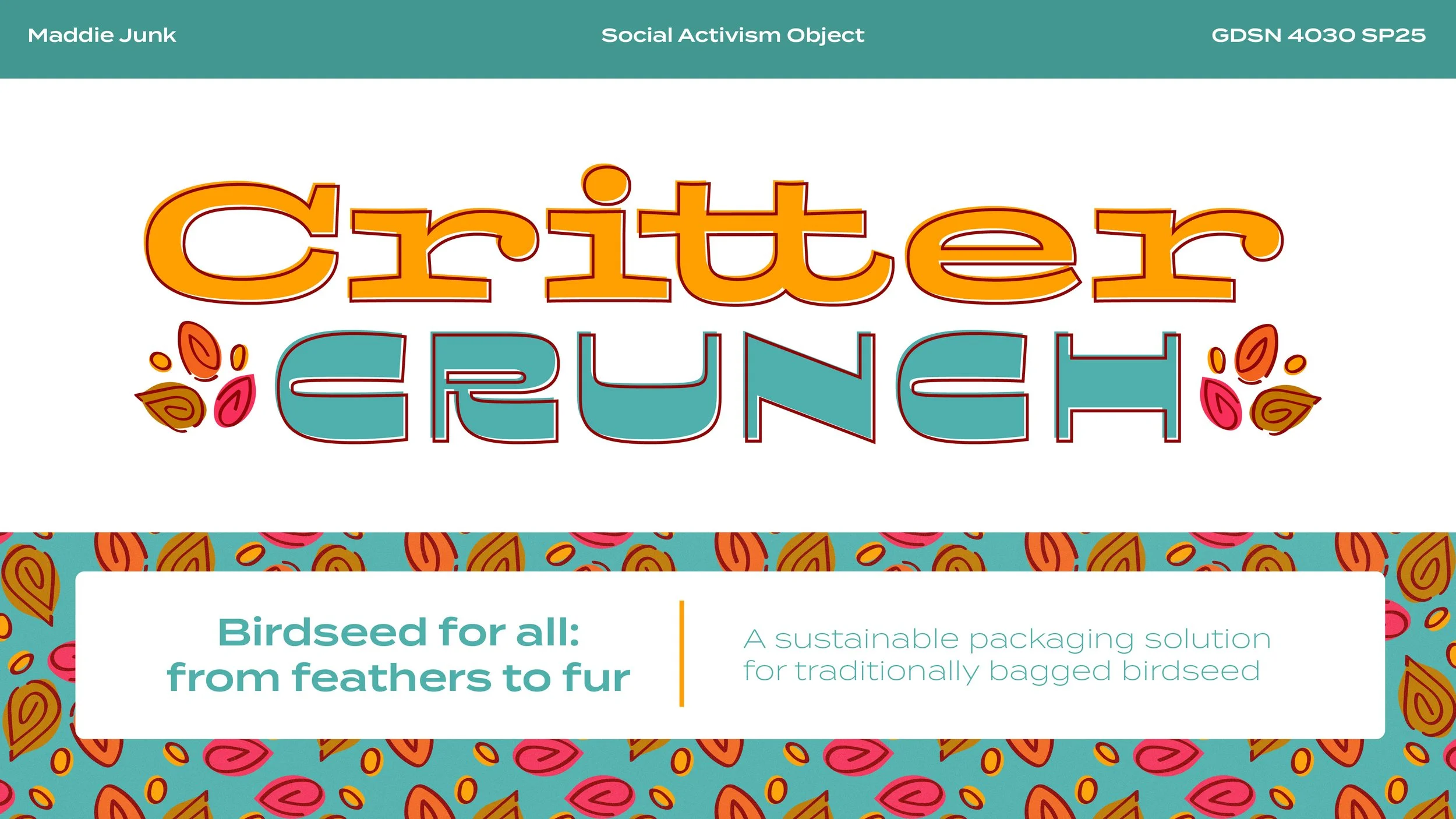
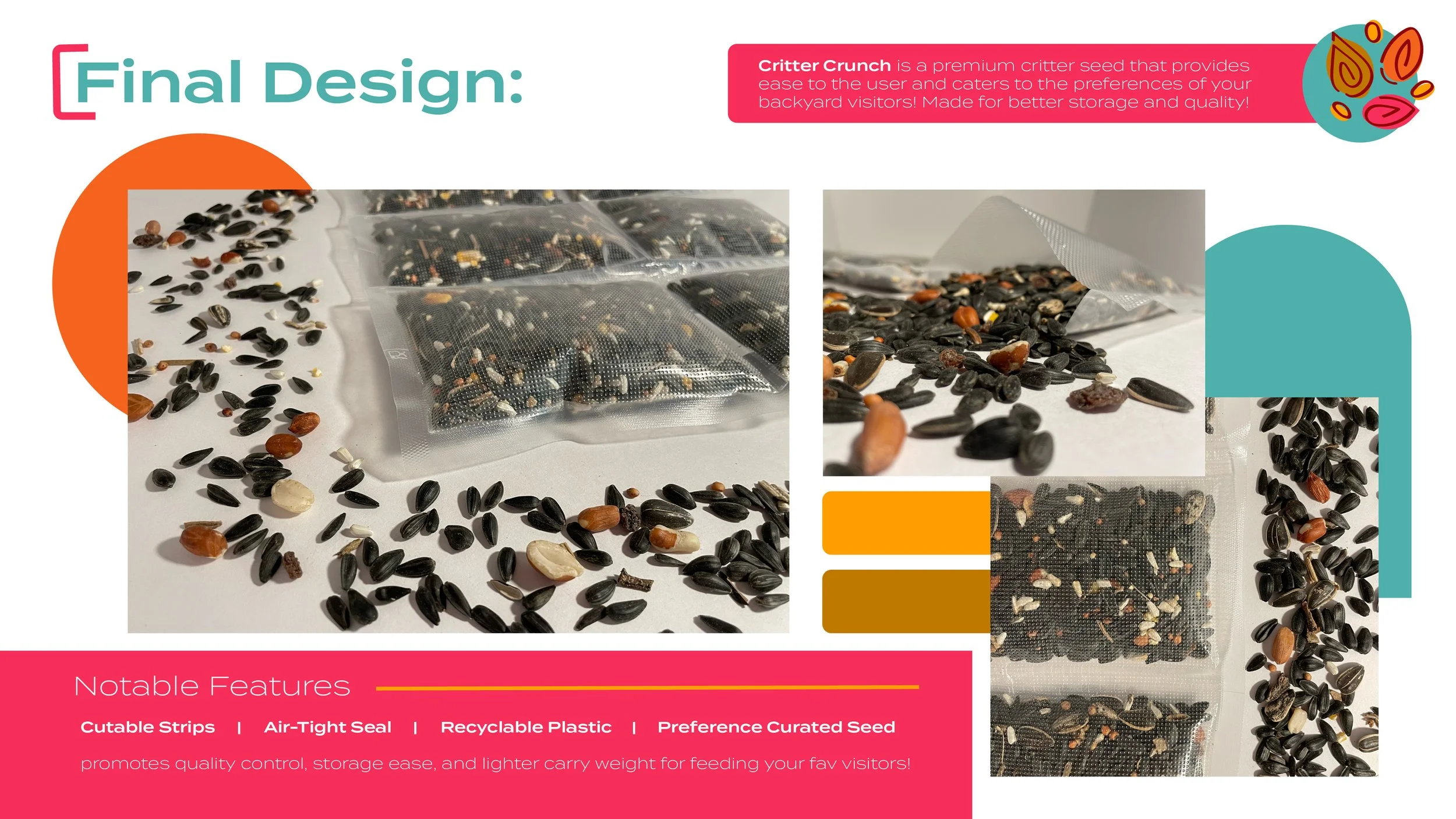
Critter Crunch is a premium critter seed that provides ease to the user and caters to the preference of your backyard visitors!
Madelyn Junk | Designer & Bird Enthusiast
2025 | Critical Thinking for Creativity and Complex Solution GenerationCritter Crunch
Overview and Key Ideas:
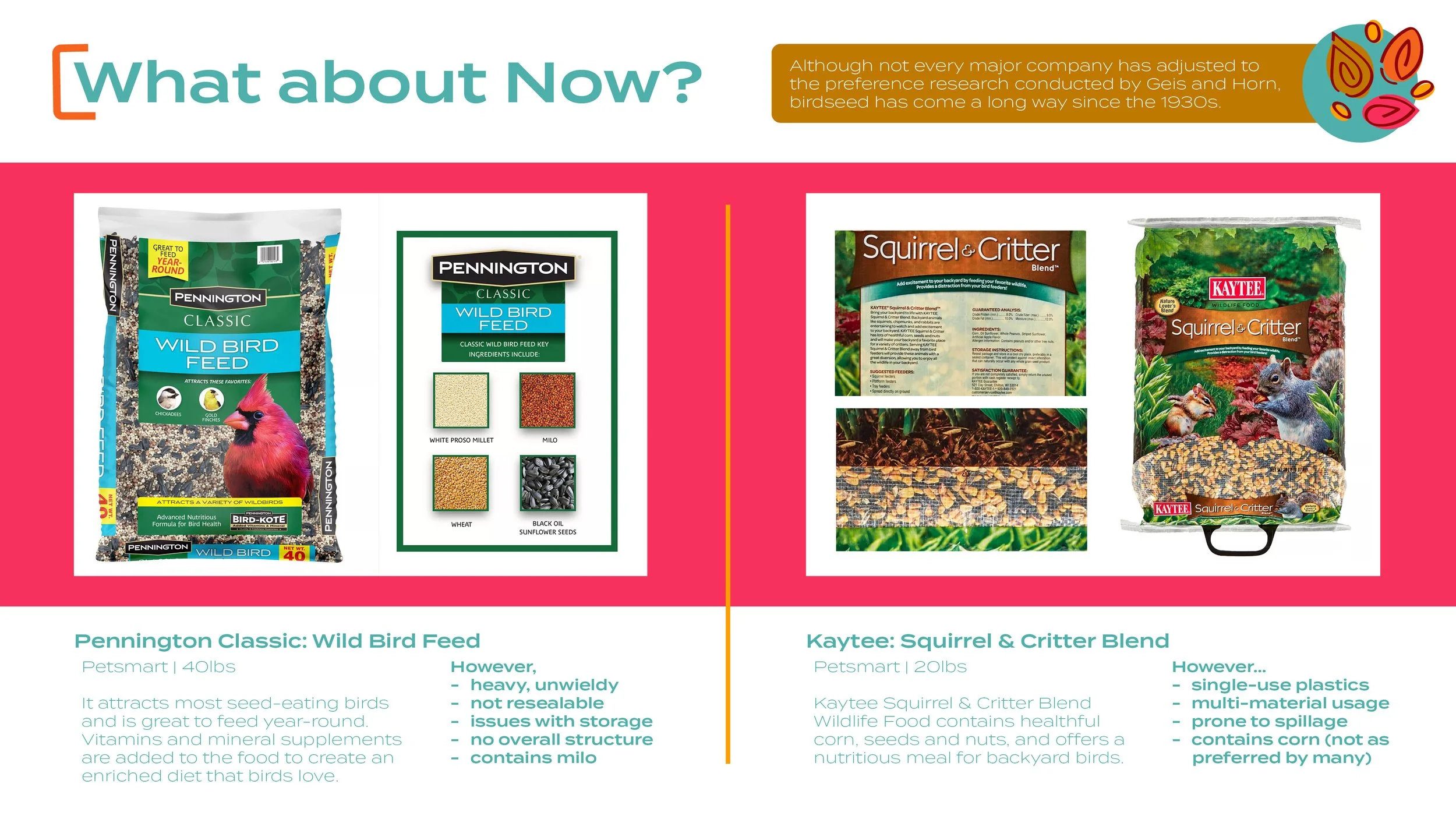
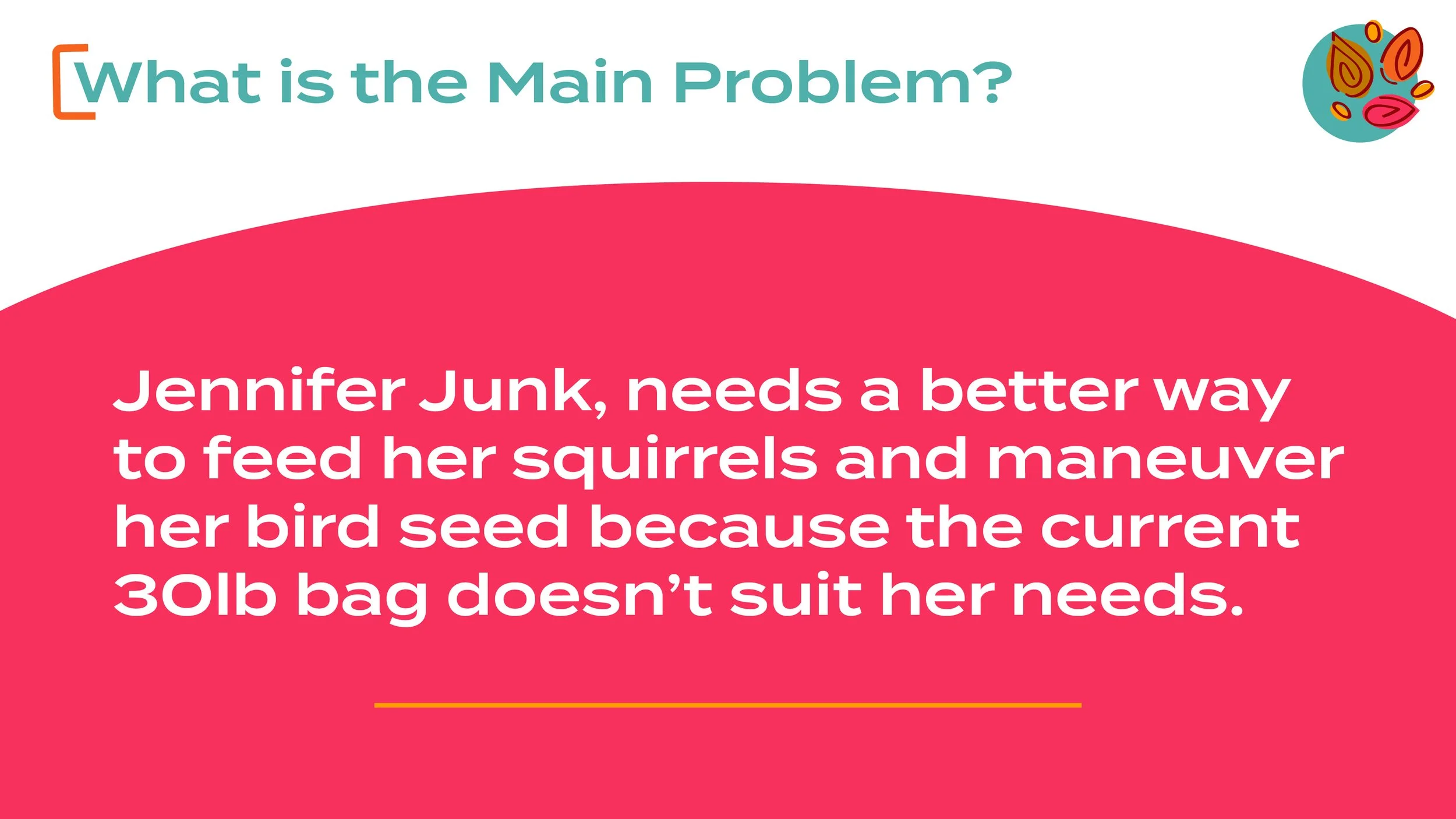
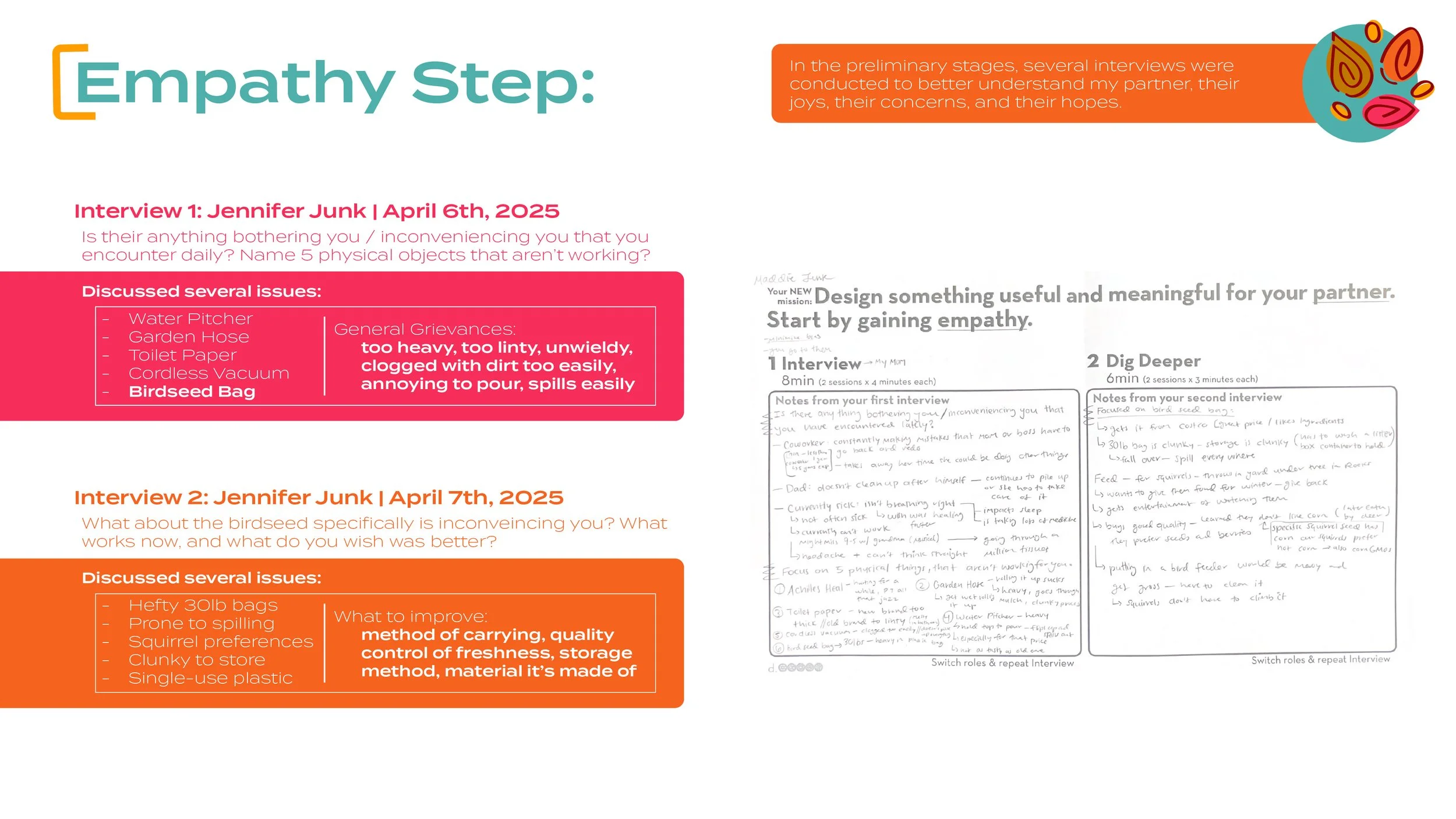
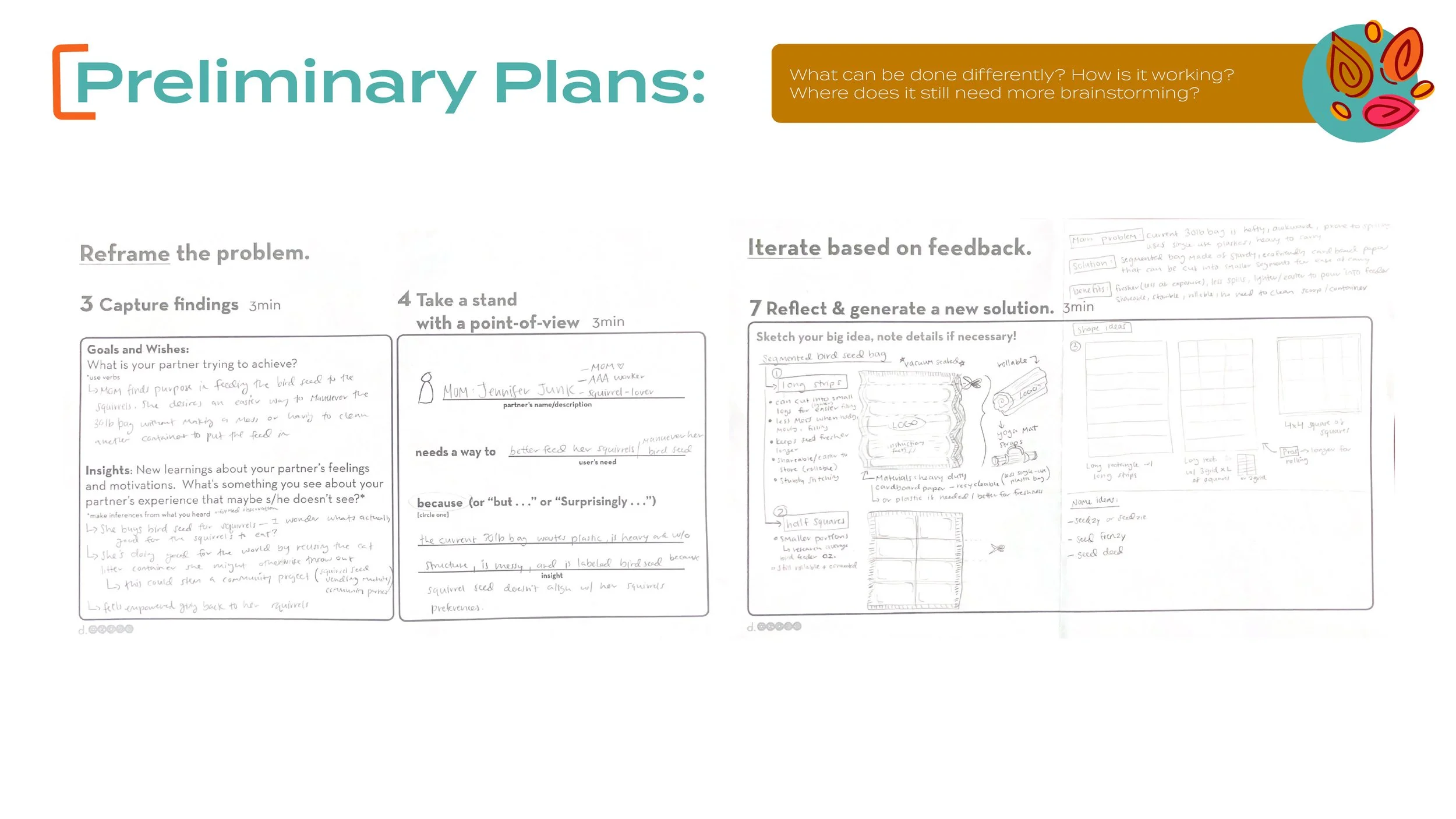
Critter Crunch is a research-based design project that targets the hassle and pitfalls of traditionally packaged birdseed by offering a sustainable packaging solution. After Jennifer, the interviewee, had expressed her discontent with the unwieldy design and plastic packaging of bulk birdseed, it sparked an interest in how traditional packaging could be adapted to better suit the needs of the birding world. By targeting issues with the method of carrying, the quality control of freshness, storage method, and its plastic exterior, Critter Crunch is able to challenge these ails with its innovative design.
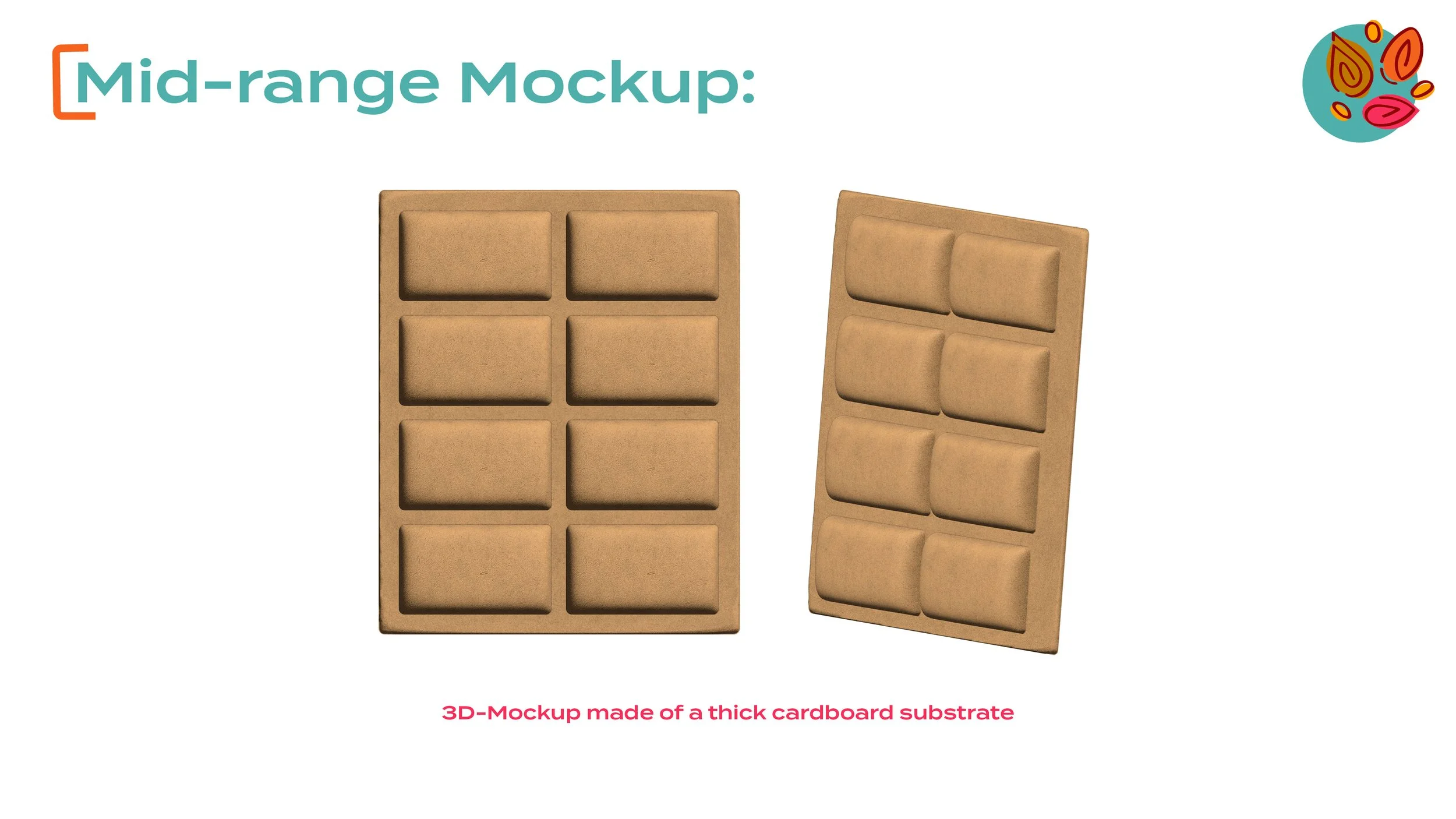
The final solution featured cuttable steps, air-tight seals, recycled plastic or a cardboard substrate, and preference curated seed. Its design allowed for longer freshness, less spilling, easier carry for all ages, and storage ease.
Created during my Design for Social Impact course in 2025
Specifics to reach: conduct an interview about an everyday object with issues, research past and current models, brainstorm and iterate on potential solutions, generate a mockup, and present findings.
Assignment details
Reflection & Analysis:
When working towards solution generation of complex problems for everyday items, it is important to first conduct research on the history of the product, noting what has been done and how it has evolved over time. Once this base foundation is set, it is equally as important to consult the target audience and understand their needs, motivations, and current understanding of the issue at hand. This perspective will allow you to step beyond your role as designer and utilize empathy and compassion to really humanize and curate that solution to the group you will be directly impacting.
In the core aspects of Critical Thinking for Creativity and Complex Solution Generation, it reads that one must demonstrate the ability to “create original, imaginative, and/or innovative solutions for complex problems that draw from multiple disciplines, balance divergent and convergent thinking, and synthesize and transfer experiences, classroom learning, and research.” This understanding of solution generation allows for a more comprehensive solution that is influenced and driven by more than just a whim.
While this project does a great job at addressing its audience and the problems that directly impact them, it does fall short in the actual packaging design. It would benefit greatly from an actual mockup of the logo on the bag or even some photo examples of it being used in real life. The project is well laid out and researched, but it could be strengthened with additional research into audience beyond just Jennifer or some peer testing to support the argument for the additions and changes made to the packaging.
❋
Research Questions:
How can the ancient Roman-style house be accurately depicted in a clue-inspired game while also adding in modern aspects of Italian culture and architecture observed during an abroad experience in Italy?
Additionally, how can aspects of ancient Roman dice games and ritual-based ludi be infused into it?
Further, how can this game be framed as a classroom tool for educators to engage their students in learning the roman-style house in a memorable and experiential way?
2026 | Critical Thinking for Interpersonal and Intercultural UnderstandingClue in the Roman-Style House:
A Twist on the Classic Board Game Featuring a Fusion of Ancient and Modern Roman Influences
Overview and Key Ideas:
Clue in the Roman Style House: A Twist on the Classic Board Game Featuring a Fusion of Ancient and Modern Roman Influences is an interdisciplinary research project. While still in the creation phase, it will result in playable Clue-inspired board game centered around the Roman style house. The project combines art history, education, and graphic design disciplines to result in a creative output alongside a research and process paper. This project is completed under the guidance of advisors, Dr. Andrea Middleton, who specializes in the ancient world, and Dr. Mark Seals, who specializes in inclusive education.
The main goal is for this project to be utilized in a classroom setting to meet both curriculum learning goals and increase engagement with the content. It aligns itself with UDL or universal design for learning, to embrace and engage students through learning and play beyond just lectures and notes.
Independent research & creative project completed over Fall 2023-Spring 2026 to be displayed at the 2026 Undergraduate Research Symposium.
Specifics: Self-designed Honors Capstone Project focused on an interdisciplinary topic with defined research questions, completed over several semesters under the guidance of two or more advisors
Project details
Reflection & Analysis:
Within the context of public good, the finished project of this board game can be used in classrooms to help teach about the Roman-style house in both its ancient and modern glory. As the murder items are based on historical artifacts and the characters are based on people who existed within the household setting, it can be used to teach students in an engaging way while providing historical perspective. Throughout time, games have been used to convey how society functions. Games, like Clue, are excellent ways to teach players about attention to detail and how to synthesize information. This unique and functional honors project finds its strength as a detail-oriented game that stresses the importance of critical thinking and deduction as it further rewards those skills through play and friendly competition.
In dissecting this project under the lens of Critical Thinking for Interpersonal and Intercultural Understanding, this project aspires to “describe and compare own cultural values, biases, and perspectives with those important to others to evaluate local, national, and global issues from multiple cultures and worldviews”. The breakdown of interpersonal and intercultural understanding connects with this creative project in sparking curiosity and exploration of another culture through exposure and play.
In its current state, this project is not fully completed and still needs to be evaluated and reviewed by an outside sourcethat is representative of the target audience (7th grade classroom). It could be additionally be strengthened by further creation of a lesson plan that goes alongside the game to better structure how teachers could use this tool to elevate classroom learning about Roman culture and society.
❋
“The question we need is, What does the world ask of us?”
Dr. Robin Wall Kimmerer | Author of Braiding Sweetgrasss
Click the image to learn more about In the Roots!
2025 | Critical Thinking for Communication - DiscussionIn the Roots: Ohio’s Native Plants
Overview and Key Ideas:
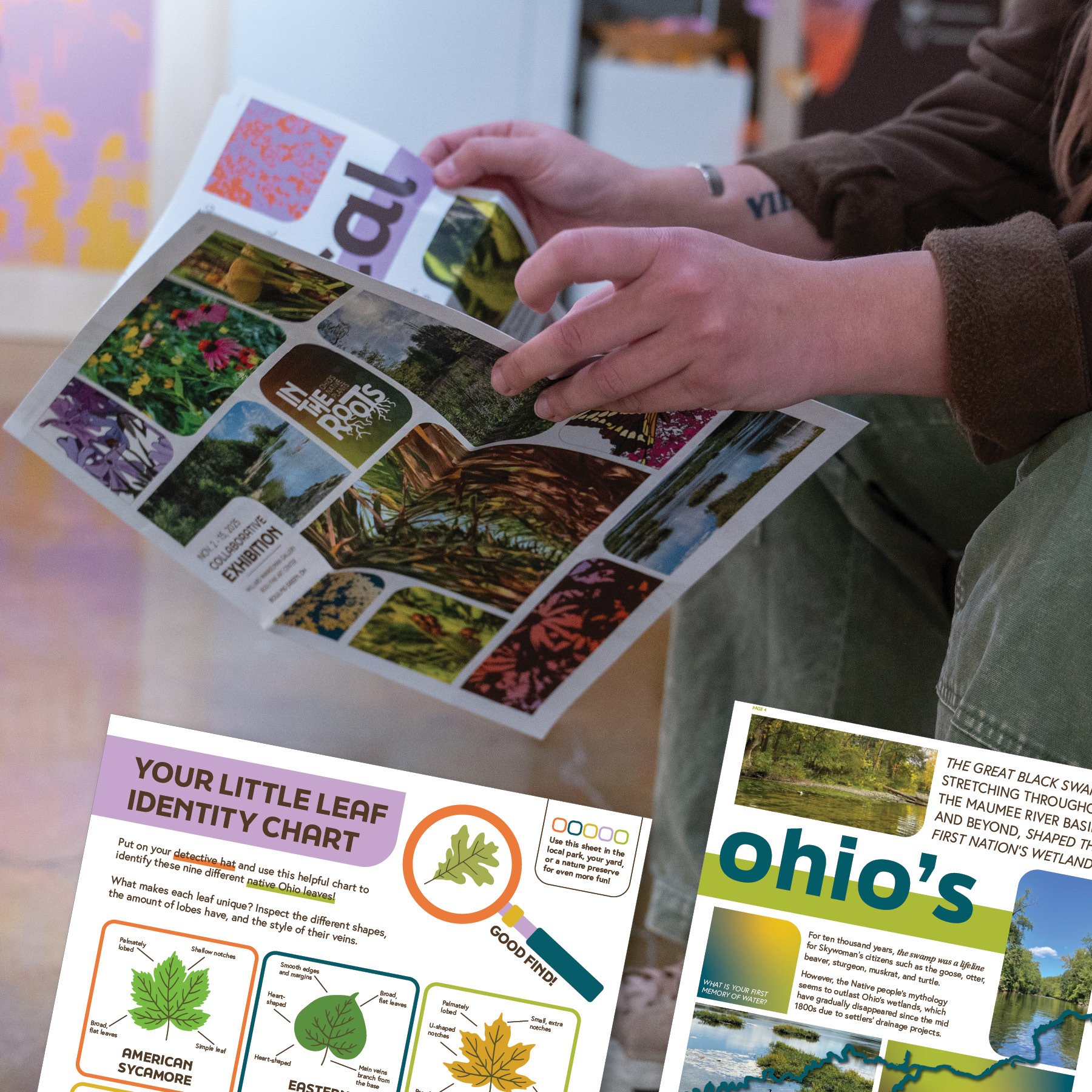
In the Roots: Ohio’s Native Plants is a collaborative student-led exhibition inspired by Robin Wall Kimmerer’s book, Braiding Sweetgrass, which combines western scientific knowledge with Indigenous ways of knowing to understand out increasingly complicated relationships with the natural world. Through three months of collaboration and dedication, eleven undergraduate and thirteen graduate students worked together to write, design, and install In the Roots.
Within the gallery walk, viewers are able to explore the history of environmental change on our region of Northwest Ohio from Indigenous settlement to the present. The exhibit features three main sections: Ohio Waterways, Sustainable Agriculture & Gardening, and Reciprocal Relationships, which are each tied back to our local environment. Along the way, these sections give advice on everything from home gardening to tackling complicated problems related to agricultural and urban run-off into our waterways. Altogether, In the Roots encourages viewers to reflect on their own experience and interconnection with nature.
Collaborative exhibition made in a Collaborative and Community Engagement Practicum (GDSN 4060) during fall 2025.
Specifics: Ideate, design, brand, and install an exhibition, produce a broadsheet, and create social media inspired by Robin Wall Kimmerer’s Braiding Sweetgrass in collaboration with a graduate museum studies course (ACS 6540).
Student Best of Show and Gold for the Exhibition & Gold for the Broadsheet Team | Toledo AAF Addy Awards
Silver for the Exhibition | AAF District 5 Addy Awards
Project details & awards
Reflection & Analysis:
When working towards critical thinking for discussion, it is important create a safe space for sharing ideas and perspectives from both the literal space holding the discussion to the headspace and mindsets that participants bring to it. While working on the exhibition, this sentiment was key in allowing for better collaboration, which allowed the team to push their ideas even further. The design team was split into many different roles and sub-teams that relied on one another to create different assets from social media and branding to the takeaway broadsheet and actual layout of the exhibition. From the brainstorm to installation, the team was driven by open group discussions and feedback, which created a tight-knit team and resulted in cohesive, comprehensive design.
In the core aspects of Critical Thinking for Communication and discussion, it reads that one must “Demonstrate collaborative discussion skills by posing questions, listening actively, imparting thoughts, opinions and/or arguments, and building on and making connections between the contributions of others to foster mutual and interdisciplinary understanding.” This understanding of communication and discussion allows for deeper conversations driven by the goal of understanding as opposed to “winning versus losing”.
As the leader of the broadsheet team, it was my job to facilitate open discussions with my teammates about our project. The broadsheet is a culmination of three different designers with unique styles that are each represented within the final piece.
While this project does a great job interacting with the target audience and connecting the exhibition to Northwest Ohio and sense of place, it does fall short in providing more calls to action. There could’ve been more representation through partnerships with local environmental organizations/preserves like Wintergarden/St. John’s Nature Preserve or the EPA. There also could have been a way for participants to directly discuss or respond to the themes presented in the exhibition like a form or interactive writing/drawing activity on site.
Jenn Stucker (Professor - 4060)
Cheryl Dong (Assistant Professor - ACS 6540)
GDSN 4060: McKenzie Hall, Matthew Joseph, Madelyn Junk, Gideon Kellenbarger, Lenox McConaughey, Hailey Pettit-Mastrolannal, Blake Rupp, Cameron Smith, Taylor Marie, Jabari Twitty, & Taylor Walterreit
ACS 6540: Delaney Cavanaugh, Yong Huang, Graham Burkhart, Kate Yin Conlan, Patrick Cook, Alex Eckhart, Maggie Fuller, Hailey Kozey, Alexander LoPreso, Dylan Rice, Roberto Rios, Cassie Small, & Sabrina Sprague
Photography: Madelyn Junk, Blake Rupp, Jake Stucker, & Jenn Stucker
Illustrations: Taylor Marie
Sweetgrass Braid & Rawhide Gifts: Roberto Rios
Collaborators
Final Thoughts
The world is ever-evolving, so we must move forward with a foundation of empathy and understanding in order to create tangible and purposeful change.